By Niklas Romberg
From cheese nights to embassy visits, student-led clubs are keeping European culture alive on campus.
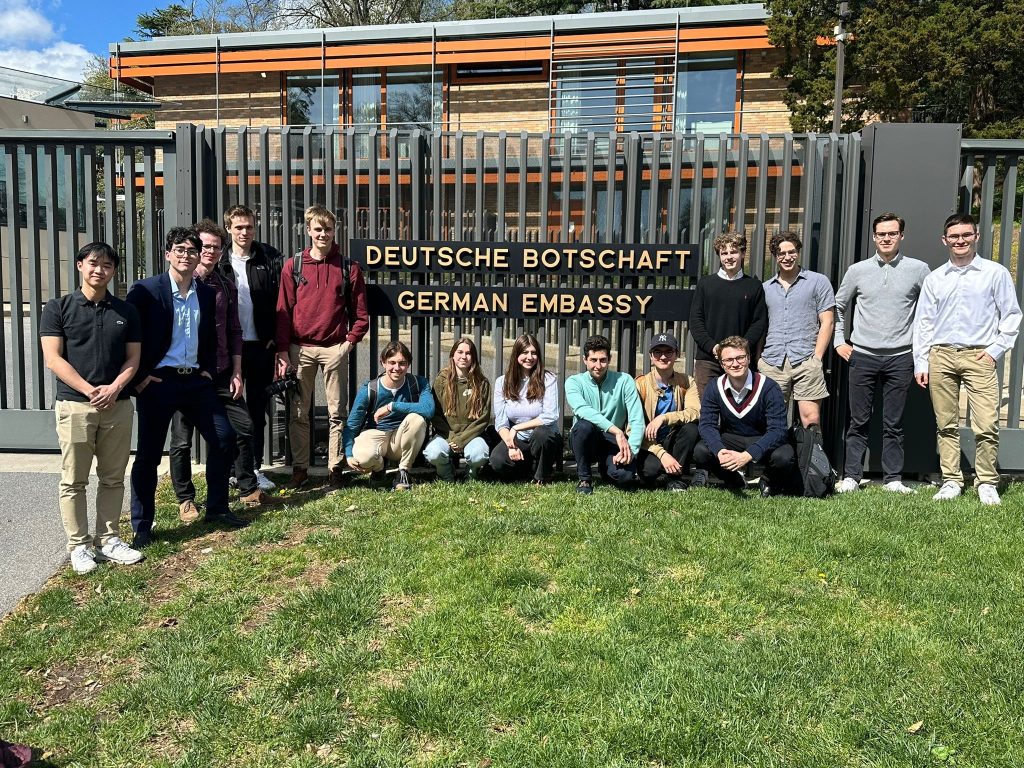
Members of German Society visiting the German Embassy in Washington, DC
For most international students, arriving at a new university in a foreign country means navigating an unfamiliar culture while trying to keep hold of your own. At the University of Pennsylvania, a constellation of student-led cultural clubs makes that balancing act a little easier. Three of them – the German Society, the French Society, and the Ukrainian Student Association – offer a window into what it means to carry a European identity at an American university, and why that identity matters more than ever.
Finding community
Nicole Hoelze, a senior from the Bay Area studying Philosophy, Politics, and Economics, has been part of Penn’s German Society since her first semester. Her connection to Germany is personal: her father is German, she holds dual citizenship, and she grew up attending German Saturday school to stay connected to the language and culture. “It’s nice to meet other people with a similar background,” she said. “People who have grown up with two sides to their culture and know what that feels like.”
The German Society has roughly 40 active members, including five to ten exchange students each semester. Nicole describes the club’s ethos as deliberately low-pressure. “Penn has a lot of pre-professional clubs,” she said. “German Society is a cultural outlet. Not much is expected of you. People can come to events they are interested in and just have a good time.”
Luna Meline, a sophomore from Paris studying economics and data science, took over as president of Penn’s French Society in May 2024 after the previous board graduated all at once. She found herself rebuilding from scratch, but the task turned out to be more manageable than expected. “Building the new board was easy,” she said. “You get to know all the French speakers on campus pretty quickly.”
The French Society has around 70 members on its rolls, though Luna estimates about 30 are truly active. The membership reflects the breadth of the Francophone world: Moroccan students, Lebanese students, Canadians, and Americans who attended French lycées in New York or San Francisco sit alongside the handful of students actually from France. “French people are the minority,” Luna noted. The club’s events reflect that diversity too, from apéro nights with cheese and charcuterie to popular crêpe evenings that draw students from well beyond the French-speaking community.
Maxim Kmits, a sophomore from Cleveland, Ohio studying political science, became president of the Ukrainian Student Association last April. He grew up in a Ukrainian immigrant family and came to Penn already embedded in the Ukrainian-American community. At Penn, he encountered something different: students from Kyiv, Lviv, and Odessa, each carrying their own experiences of a country at war. “It was eye-opening,” he said. “We have common values, but very different lives.”
What the clubs do
Each club has its own personality, but all three share a commitment to something beyond social events. The German Society balances cultural programming like pretzel-making and Karneval celebrations with more serious engagements: an annual German-American conference at Harvard and a trip to the German Embassy in Washington, D.C. to meet officials. Nicole appreciates that range. “We have serious events, but also chill events,” she said. “People can choose what they want.”
The French Society leans into the cultural. Luna frames its mission simply: to create a space where members can speak French informally, keep up with the culture, and take a break from the relentless pace of Penn academics. “The whole idea is to be relaxed,” she said. “We frame events as study breaks. Penn’s club culture can be very competitive. We want to be the opposite of that.”
For the Ukrainian Student Association, the mission carries a different weight. The club hosts social mixers and casual events, but its most impactful moments have come through speaker events. Last year, the club co-hosted an event with Penn Women in Healthcare that brought a former First Lady of Ukraine to campus. “It was the most inspirational event I’ve attended at Penn,” Maxim said. “I got to have a personal conversation with her as a first-generation Ukrainian-American. That meant a lot.”
The club also takes on a quiet but deliberate role in shaping how Penn students understand the war in Ukraine. Maxim is candid about the misconceptions he encounters. “A lot of Americans think Ukraine is inevitably losing,” he said. “That it’s a war of attrition and the outcome is settled. But that’s not true. Russia has made territorial gains, but nothing decisive has been achieved. There are still lives at stake every day. People look at this from a third-person perspective and forget that.”
Being European at Penn
All three presidents reflect on what it means to hold a European identity at an American university, and their answers are more complicated than you might expect.
Luna describes Penn as a place of clusters. Europeans, she says, tend to gravitate toward other Europeans naturally, but she has consciously pushed back against that tendency. “I expected to end up in a bubble of Europeans,” she said. “I purposely tried to diversify. Most of my friends are American.” She sees that as one of the reasons she chose Penn over universities in Europe in the first place. “You have so many options to study in Europe and you still choose the US. That says something.”
Nicole describes her identity as something she carries inside rather than something she displays. “I’m American first,” she said. “But it’s interesting to tell people about the German side. In business especially, having a global perspective and being able to speak another language is genuinely helpful.” For her, German Society gave that side of her identity a home on campus. “Growing up I sometimes felt like just an American with a German side,” she said. “At German Society, I got to meet other people who grew up the same way, with one foot in each culture.”
For Maxim, the question of European identity is geopolitical as much as cultural. “Since the war, most Ukrainians have leaned strongly toward a European identity,” he said. “That’s reflected in the community here too.” He is still figuring out what comes after Penn, but moving to Europe to support Ukraine’s reconstruction is something he thinks about. “I want to be on the ground and support what comes next,” he said.
Why it matters
Asked why student-led cultural clubs matter on a campus like Penn’s, all three give versions of the same answer: they fill a gap that the university’s academic and professional infrastructure cannot.
“For international students, moving to the US is scary,” Luna said. “It’s important to have a place that feels like home.” Nicole frames it in terms of Penn’s broader identity as an international university. “Having students from all these different backgrounds is only valuable if there are spaces for them to actually share those backgrounds,” she said. “Cultural clubs do that. They give you a more global mindset, which is something Penn says it values.”
Maxim puts it most directly. “The point of a university is to think and to learn,” he said. “The Ukrainian Student Association exists to share the Ukrainian perspective with people who might not otherwise encounter it. That feels especially important right now.”
For more information about student organizations at Penn, visit the Office of Student Affairs.
The author would like to thank Maxim Kmits, Luna Meline, and Nicole Hoelze for generously sharing their time and experiences for this piece.
Author Bio:
Niklas Romberg is a Bachelor of Arts in International Relations candidate at the University of Pennsylvania, Class of 2027.