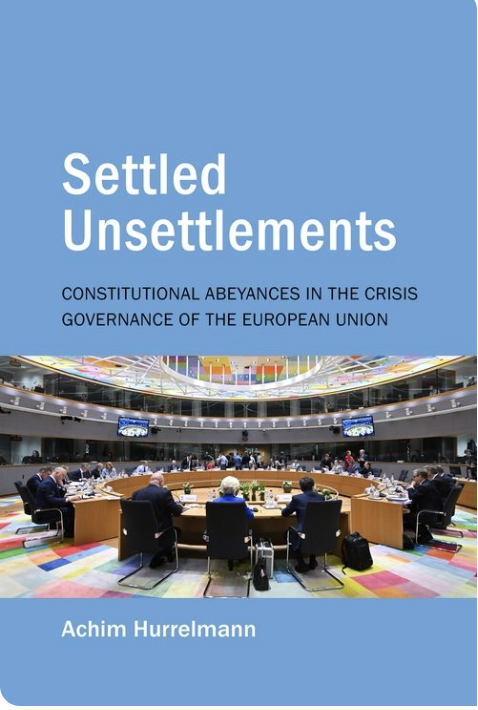
Join us on Thursday, December 10, 2026 at 9am ET/3pm CET for a discussion of Settled Unsettlements: Constitutional Abeyances in the Crisis Governance of the European Union, by Achim Hurrelmann (Carleton University). The author will be joined by Nicole Scicluna (Hong Kong Baptist University) and Thomas Verellen (Utrecht University).
Settled Unsettlements is part of CES’s Understanding Europe Book Series with Agenda Publishing and Edinburgh University Press. You can learn more about the book here: https://edinburghuniversitypress.com/book-settled-unsettlements.html
When: December 10, 2026
Who: Achim Hurrelman, Nicole Scicluna, and Thomas Verellen
About the book:
Constitutional ambiguity has been an important enabler of European integration. Achim Hurrelmann argues that although this can cause problems, it often remains the best option for holding the European Union together and has shaped how the EU has responded to its recent crises.
This book reinterprets European integration using the concept of “constitutional abeyances” – originally developed by Michael Foley and not previously applied to the EU – which are unresolved issues that political elites avoid politicizing to prevent conflict. Hurrelmann shows that it is a concept that can help us better understand the EU: what it is, how it works, why it sometimes does not work, and how it responds when crises hit. He shows that, although these strategies may be criticized, they ultimately have contributed to the EU’s resilience in face of the crises over the euro, migration and rule of law.
Speaker Bios:
Achim Hurrelmann: Achim Hurrelmann is Professor of Political Science and Co-Director of the Centre for European Studies at Carleton University in Ottawa/Canada. His work examines dynamics of politicization and de-politicization of regional and global governance, especially in the European Union (EU). He has also published on multilevel governance, the politics of trade, and Canada-Europe relations. He is principal investigator of the Research Network on Trade Politics in North America and Europe (TRADEPOL), funded through a Partnership Grant from the Social Sciences and Humanities Research Council of Canada.
Nicole Scicluna: Nicole Scicluna is an Assistant Professor in the Department of Government and International Studies at Hong Kong Baptist University. Her research interests include European integration, the EU’s legal and constitutional system, and the relationship between international law and international politics. She is the author of two books: The Politics of International Law (OUP, 2021) and European Union Constitutionalism in Crisis (Routledge, 2015). Her work has been published widely, including in International Affairs, the Journal of European Public Policy, the Journal of Common Market Studies, the International Journal of Constitutional Law, West European Politics and the European Law Journal.
Thomas Verellen: Thomas Verellen is a tenured Assistant Professor of EU and International Law at Utrecht University, where he coordinates and teaches a range of EU law courses and co-leads a research unit on the role of values in the EU’s international trade policy. He also serves as Managing Editor of the Utrecht Law Review. Starting in 2026, he co-teaches a module on the law and economics of EU trade policy at the Université libre de Bruxelles (ULB). His research examines how EU trade policy responds to geopolitical change. Drawing on prior experience as a practicing trade attorney, he has been a close observer of how the EU has been transforming its trade policy toolbox, using traditional instruments in new ways, reforming existing tools, and introducing entirely new mechanisms to safeguard the EU’s strategic autonomy and economic security. These transformations, however, increasingly test the EU’s constitutional commitment to values like the rule of law, human rights, and democracy—tensions that sit at the heart of his research and normative critique.