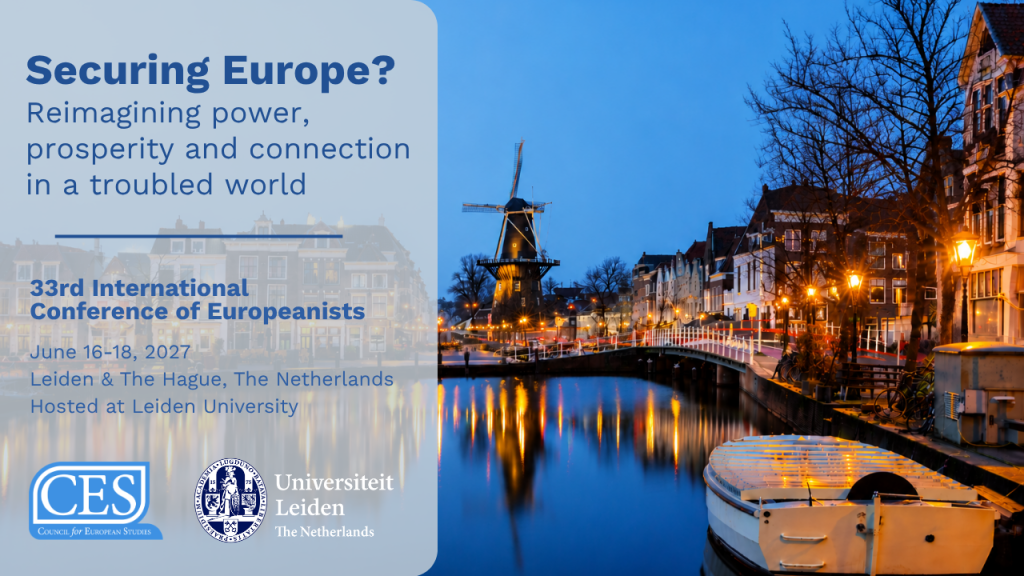
33rd International Conference of Europeanists
June 16-18, 2027
Conference Host: Leiden University
Location: Leiden and the Hague, the Netherlands
Conference co-chairs: Vera Scepanovic (Leiden University), Joost Augusteijn (Leiden University), Natascha van der Zwan (Groningen University), and Annick Masselot (University of Canterbury)
We are now accepting proposals for the 2027 conference! Deadline has been extended to October 23, 2026.
Securing Europe? Reimagining power, prosperity and connection in a troubled world
Across Europe, many citizens experience a sense of disempowerment in the face of mass violence and genocide, shortages of ‘critical’ raw materials and essential hospital staff, rising bills and relentless data breaches. The ambient dread pouring off the screens in our pockets is fuelling a growing conviction that key developments shaping Europe’s present are no longer fully in its control. It is little wonder, then, that security in all its forms has come to dominate the political and public debate, often accompanied by a narrow repertoire of proposed solutions. Autonomy is increasingly prized over interdependence, hard borders and expanding defence budgets prioritised over social welfare and international solidarity, and democratic norms subverted in the name of protection.
The 2027 CES conference invites scholars from different disciplines to examine the choices shaping Europe today and to explore what it would mean to truly make Europe secure. Contributions using diverse and interdisciplinary lenses are welcome, especially those addressing questions such as: How could European citizens genuinely benefit from European alternatives in sectors currently dominated by global firms? How much of the world’s resources and markets must Europe continue to command to sustain its prosperity? Is prioritizing defence over social security a necessary trade-off, or a false one? Can Europe enhance its security and resilience without addressing its structural inequalities? What are the costs of underestimating the threats from external actors, and what are the dangers of exaggerating them?
The Netherlands offers a compelling point of departure for these conversations. Throughout its history, it has pursued multiple, sometimes contradictory, paths to security and prosperity. It imagines itself a kikkerlandje – ‘small frog country’ that depends on the strength of its alliances and international laws for survival. Yet as a colonial power itrepeatedly bent those same laws in pursuit of self-interest. At the forefront of climate vulnerability, it has kept itself above water by alternatively holding the sea back, letting the water flow through, and making sure that every child learns to swim. Leiden University, our host institution, has long presented itself as a bastion of freedom that sheltered persecuted scholars and resisted occupying powers, even as it trained colonial administrators and built collections and knowledge systems deeply embedded in the Dutch Empire. Reimagining Europe’s future also requires confronting the complex configurations of power, prosperity and connection that emerged from such troubled pasts.
In this spirit of reckoning and renewal, proposals are invited for panels and papers that approach the question of security from a wide range of historical, regional, and disciplinary perspectives. Contributions that draw on alternative conceptions of security are strongly encouraged, as are those that examine how past responses to insecurity may illuminate, complicate, or constrain the possibilities for the present and future. Particular welcome is given to contributions grounded in epistemic humility; work that asks what might be learned in and about Europe from parts of the world used to living with uncertainty and that never enjoyed the illusion of being at its centre.
The application deadline has been extended October 23, 2026. Notifications will be sent out by December 18, 2026.
2027 Local Organizing Committee
| Maxine David (Leiden University) | Sanderien de Jong (Leiden University) |
| Donna Reynolds (Leiden University) |
2027 Conference Program Committee
| Alexandre Alfonso (Leiden University | Daniel Schade (Leiden University) |
| Maria Spirova (Leiden University) | Dennie Oude Nijhuis (Leiden University) |
| Andreas Hofmann (Leiden University) | Matt Broad (Leiden University) |
| Brian Shaev (Leiden University) | Antoaneta Dimitrova (Leiden University) |
| Aneta Spendzhraova (Maastricht University) | Ferenc Laczo (Maastricht University) |
| Greg Fuller (Groningen University) | Donato Di Carlo (London School of Economics) |
| Maartje van der Woude (Leiden University) | Camille Nessel (Université libre de Bruxelles) |
| Hanna Muehlenhoff (University of Amsterdam) | Andrea Apollonio (Université libre de Bruxelles) |
| Arianna Rotulo (Groningen University) | Tiffany Grace Williams (Jena University) |
| Seda Gurkan (Leiden University) | Astrid van Weyenberg (Leiden University) |
| Louie Dean Valencia (Texas State University) |