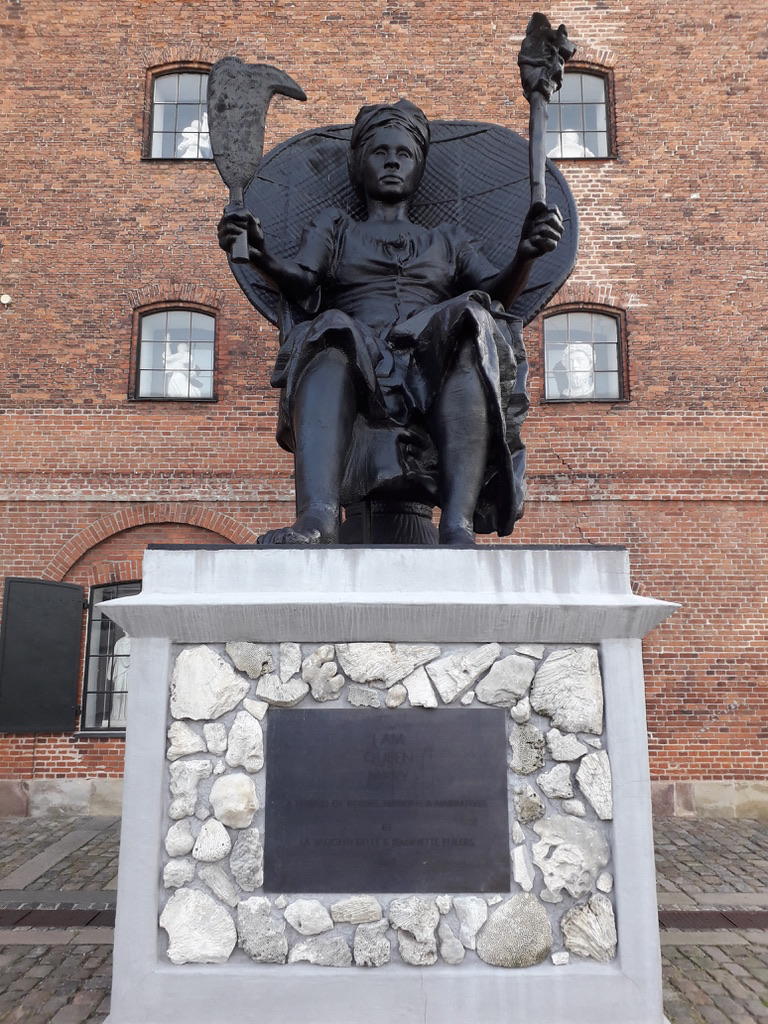
I am Queen Mary Statue in Copenhagen. The statue is a collaboration by artists La Vaughn Bell and Jeanette Ehlers to memorialize Denmark’s colonial impact in the Caribbean. Read more about their work here. Photograph by Iyiola Solanke.
CES is excited to announce the establishment of a new Research Network on Decolonial Theory and De-/Coloniality.
Network Co-Chairs:
Iyiola Solanke (Oxford University, Somerville College) iyiola.solanke@law.ox.ac.uk ·
Janine Silga (Dublin City University) janine.silga@dcu.ie
Akasemi Newsome (University of Berkeley) akasemi@berkeley.edu
Overview of RN:
It is now widely accepted that a long-standing deficit in European studies per se is a deep and theoretically informed understanding of the role that European colonialism has played – and coloniality continues to play – around the world. The purpose of this CRN is to consider in detail what happens when we take coloniality as the starting point for our interaction with European studies? How does decolonial theory amend the purpose, principles and practice that inform our research and teaching? What traditions need to change and what remains the same? Is it even possible for European studies to “shake off its commitment to colonial ways of thinking?” (Meghji)?
This decolonial agenda in European studies thus seeks to open the field to new knowledge and new knowers by creating a space to highlight deficits and reflect upon the euro-centrism that underpins and informs existing canons and their narratives. It promotes the use of decolonial theory to identify these deficits and thereby contribute to a European future built upon cognitive justice, conviviality and solidarity. This would be a move away from a framework of thinking that is Eurocentric and privileges this way of seeing above other experiences and perspectives from parts of the world. It is a potentially exciting approach, broader than diversifying – diversity is only part of the decolonisation agenda because diversity can still exist within a “western bias” – which can open up the world of European studies to a new generation of scholars and audiences.
This CRN therefore aims to provide opportunity for informed and constructive reflection on across the field of disciplines that fall under the aegis of the Council for European studies: law, political science, history, cultural studies, economics and more. We plan to investigate what is seen as worthy of study, as well as the way in which core issues pertaining to Europe are told and who has legitimacy to tell those stories. Reflection on decoloniality also raises the broaderquestion of who research and scholarship serves and who higher education institutions need to be training to create accessible and sustainable education systems that support and strengthen democracy.
The network will gather scholars critically engaged with decoloniality and coloniality. It will offer a forum at the CES for academic interest in excavating histories, identifying themes and studying the global impact of European colonialism in the past and global coloniality in the present. In pursuing these goals, we hope to collaborate with thematically-adjacent CRNs in the CES.
The RN is now open for membership sign ups. You should sign up for the RN when you renew your CES membership. The co-chairs will donate membership dues from the 2026-2027 academic year to the I Am Queen Mary Project.
To be added to the listserv, please email memberships@ces-europe.org.