By Niklas Romberg
Henry McDaniel was part of the inaugural cohort of Penn’s European Studies Institute. Now, just months after graduating, he is living and working in one of Europe’s most contested corners.
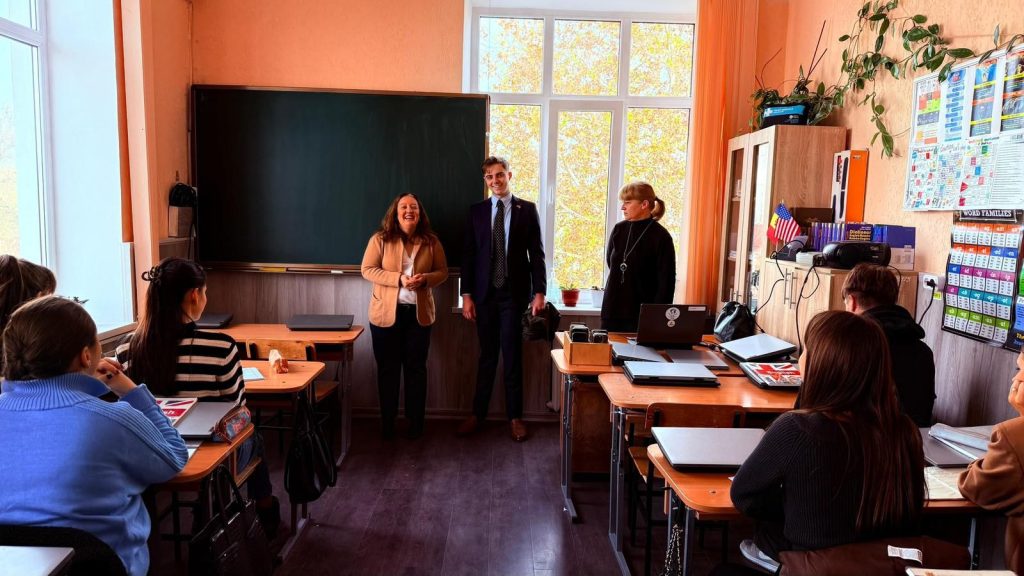
McDaniel (middle) in his classroom at Ion Creanga Theoretical Lyceum with the Deputy Chief of Mission at the U.S. Embassy in Moldova
When Henry McDaniel arrived at the University of Pennsylvania, he had a clear goal: study abroad in Russia, learn the language, and immerse himself in the region he had been drawn to since high school. The war in Ukraine made that impossible. What it did instead was sharpen his focus and accelerate a career path that has taken him, via Penn’s European Studies Institute and a Fulbright scholarship, to the small former Soviet republic of Moldova, where the consequences of Russia’s invasion play out in electricity bills, refugee flows, and the quiet work of keeping a fragile democracy on course.
McDaniel graduated from Penn in 2025 with a degree in Russian, Eastern European, and Eurasian Studies and Diplomatic History. During his junior and senior year, he participated in the European Studies Institute (ESI), a year-long research fellowship led by Professor Mitchell Orenstein that places a small group of Penn students in an intensive research program culminating in a senior thesis. His thesis examined European Union enlargement policy in three post-Soviet candidate states: Georgia, Moldova, and Ukraine, each of them targeted by Russian hybrid warfare in the form of disinformation campaigns, covert energy disruption, and election interference. His central argument was that Russia’s goal in each case was the same: to pull these states out of the EU’s orbit before they could consolidate their path toward membership. The thesis was awarded the CES Undergraduate Paper Prize in 2025.
The Research and the Trip
Moldova was not just an abstract case study for McDaniel. It was the place where the dynamics he was writing about were most visible and most contested. In the October 2024 parliamentary elections, a coalition of pro-Russian parties faced off against the Party of Action and Solidarity, the incumbent pro-European government. The election was accompanied by a proliferation of Russian disinformation and vote-buying operations. The pro-European party held on, narrowly, and Moldova’s path toward EU membership was preserved, at least for that moment. “Those elections were consequential,” McDaniel said. “If the result had gone the other way, it could have been a turning point.”
The ESI trip in January 2025 brought McDaniel and his cohort to London, Brussels, Paris, and Berlin, where they met with officials, researchers, think tank analysts, and representatives from international organizations. For McDaniel, whose research focused on security and hybrid warfare, the standout meetings were at NATO headquarters, where he spoke with intelligence officers, and at the European External Action Service in Brussels, the EU’s equivalent of a foreign ministry, where the director gave the group a comprehensive briefing on hybrid warfare across the continent. He also met with analysts at the SWP, a leading German foreign policy think tank, whose insights on Russian operations within the EU proved directly useful to his thesis. “Those meetings shaped the final argument of my thesis in ways that sitting in a library never could have,” he said.
Choosing Moldova
Before graduating, McDaniel worked as a research assistant for Professor Orenstein and completed an internship at Penn’s Cultural Heritage Center, where he documented the Russian military’s destruction of culturally significant non-military sites in Ukraine, including libraries, theaters, and cultural centers. He continued that work through a student fellowship with the State Department. But the pull toward the region itself was strong, and when the Fulbright opportunity in Moldova came up, it was an easy decision.
“My goal since arriving at Penn was to become a genuine regional expert,” he said. “That means lived experience in the region, not just reading about it from Philadelphia.” Moldova was, in many ways, an ideal fit. It is a small country navigating an enormous question about its future, it has a large Russian-speaking population, and it sits directly in the shadow of the war in Ukraine. For someone whose academic work has centered on exactly that set of dynamics, being there in person is both professionally and personally valuable.
The Fulbright grant is officially nine months long. McDaniel is already seven months in and has extended through the summer. His primary role is as a high school English teacher, where he teaches topics related to culture and the anglophone world. He also volunteers teaching Ukrainian refugees and coordinates programming at American Spaces across Moldova, a network of cultural and youth centers that serve as hubs for education, career development, and American-themed events. Through that work, he has developed a close view of the US-Moldova relationship, which he describes as genuinely strong. The two countries collaborate on transnational crime, infrastructure projects, and educational exchange, and the American Embassy maintains a robust presence in the country.
Moldova Up Close
The effects of the war in Ukraine are not abstract in Moldova. Energy prices have risen sharply. Just recently, bombing in Ukraine struck an oil facility near the Dniester River, cutting off water to parts of the country. Electricity costs have become a daily concern for ordinary Moldovans in ways that underscore how directly the conflict next door shapes life in this small country.
McDaniel has also traveled to Transnistria, the Russian-backed breakaway region within Moldova’s borders, three times during his fellowship. He has lectured at the state university there, including a talk comparing Thomas Jefferson and Catherine the Great as leaders of the Enlightenment.
What strikes him most about Moldova is the character of its people. “Moldovans are extremely family oriented and incredibly resilient,” he said. “They have been through a great deal since 1991, economic hardship above all, and yet they are among the kindest and most welcoming people I have encountered. They would go to great lengths to help you.”
Looking Ahead
McDaniel is clear about what he wants to do next. His long-term goal is to work on the National Security Council with a focus on Russian and Eastern European affairs, and his current path is oriented toward a career as a Foreign Service officer. The Fulbright has reinforced rather than complicated that ambition. “Being here, away from the Penn bubble, has encouraged me to wholeheartedly pursue what I actually want to do,” he said. “This region matters. The work matters. I want to be part of it.”
For current Penn students interested in following a similar path, McDaniel points to the constellation of opportunities that already exist at Penn: ESI, the European Studies Minor, Perry World House, and the range of faculty working on European and post-Soviet affairs. “There are great things happening and new opportunities emerging,” he said. “The infrastructure is there. You just have to engage with it seriously.”
His own trajectory, from an ESI thesis on Russian interference in Moldova to actually living and working in Moldova on a Fulbright, is perhaps the clearest illustration of what that serious engagement can produce.
For more information about ESI and the European Studies Minor at Penn, visit web.sas.upenn.edu/european-studies.
Author Bio:
Niklas Romberg is a Bachelor of Arts in International Relations candidate at the University of Pennsylvania, Class of 2027.