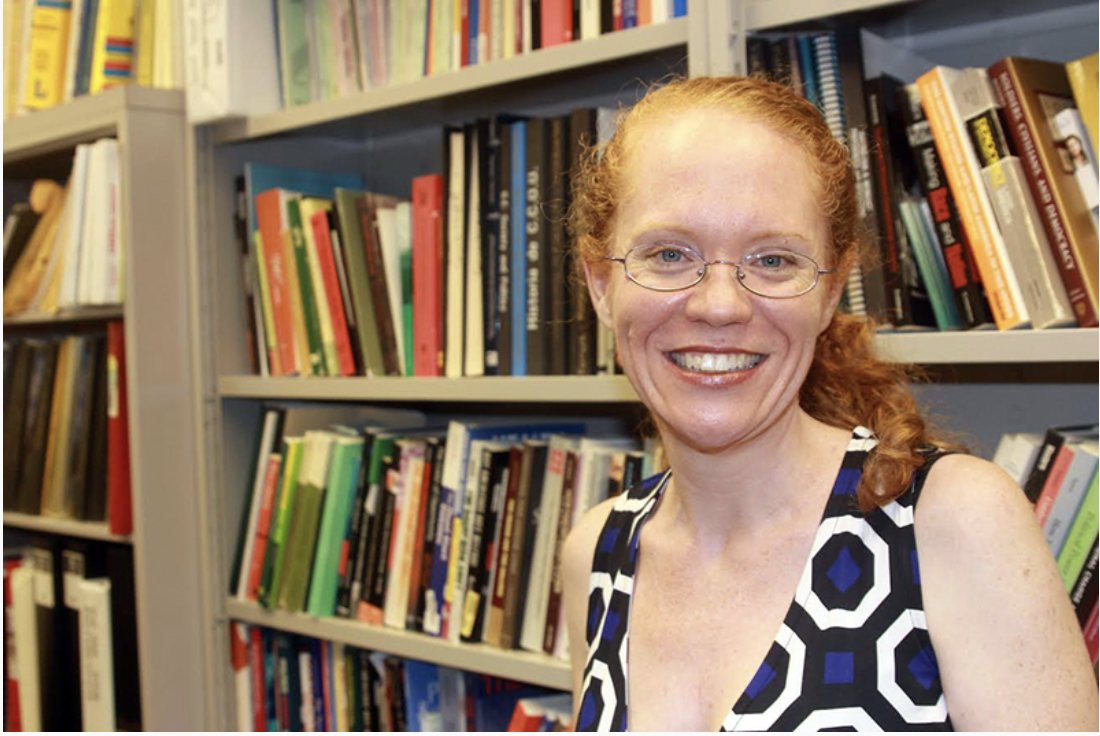
This month we are highlighting Sara Watson, CES’s new Executive Committee chair! Sara Watson is Associate Professor of Political Science at the Ohio State University. Sara answered a few questions for us about her experience with CES, her research, and her goals as CES chair.
Could you tell us a little about yourself and your research?
I’m a political scientist at The Ohio State University. My research examines how institutions shape political representation, governance, and social conflict across the advanced democracies of Europe. My first book, The Left Divided (Oxford University Press, 2015), explored how divisions within the left shape the welfare state. More recently, my work has turned to how globalization and deindustrialization are reshaping political representation in Europe—particularly in France, where I’ve studied the decline of labor unions, anti-systemic protest, and radical-party competition, among other themes. I’m delighted to be stepping into the role of Executive Committee Chair, and I look forward to supporting the CES community.
How did you first become involved with CES?
I first attended the conference as a graduate student. Back then, the conference was only held every other year in the Palmer House in Chicago in March. I had been told both by my advisors and by older graduate student colleagues that it was a good conference because it was small and more community-oriented—and they were right! It was cold and windy outside, but probably for that reason, my recollection is that nearly all the attendees attended all the panels in their particular area (welfare and political economy, history, etc.). That commitment to sitting together in the same conference room from 8:30 to 5 contributed to a real sense of community. Today we’re much larger, of course, but I think CES still retains that same sense of collegiality and support.
Is there a particular CES experience or connection that has been especially meaningful to you?
I will always remember my first CES conference, where a senior colleague, Robert Fishman, took the time to sit down with me for an hour-long coffee after my panel presentation. He gave me detailed and really constructive feedback on my paper about rural politics in Spain. That type of intellectual generosity is, to me, what makes CES special. It’s a place where scholarly exchange is grounded in supporting one another’s scholarship, not just promoting your own work.
What are you most looking forward to as you begin your term as chair?
What I am most looking forward to is the chance to support the type of community that made CES so meaningful to me early in my career. I’m excited to help set up structures which strengthen connections between senior scholars and those just entering the field, and to ensure that CES remains a welcoming intellectual home for the next generation of Europeanists.
What opportunities or challenges do you see for European Studies today?
I know there are a lot of challenges these days but let me talk about the opportunities first because I think they’re easy to miss. So many of today’s most salient questions, be they social, regulatory or geopolitical, have Europe at their center. We think about any of a number of important issues—the fraying of the transatlantic relationship and its implications, the war in Ukraine, climate change and energy security, the causes and consequences of demographic change, the nature of identification with the national community, data governance and the regulation of technology. On all of these, Europe is a laboratory for asking big questions about the world. That makes European Studies as substantively relevant as it has ever been.
The challenges I worry about are structural. CES is a transatlantic organization, so it’s useful to think about the related but somewhat distinctive challenges that our North American and European colleagues face. In the United States, funding for European Studies has been declining—partly a consequence of the broader move away from area studies, and partly the shifting priorities of both the federal government and major philanthropic foundations. The result is a shrinking pool of substantively trained Europeanists. I don’t think this is only a matter of numbers; it really gets to substance. As fewer students are educated in the history, languages, and social structures of the places they study, we risk a flatter kind of scholarship—one that perhaps knows how to test propositions but has fewer people equipped to understand which propositions actually matter (let alone why). Our Canadian colleagues face a related squeeze (less a retreat from area studies than fiscal pressures alongside a growing insistence that programs prove their economic relevance), but my sense is that the effect is much the same. In Europe, of course, the field of European Studies remains vital, but there too we see growing pressures, with more scholars competing for a shrinking pot of resources and real questions of disparity across Europe’s research ecosystems.
I’m not going to pretend CES is immune to these structural problems. We too are feeling funding pressures, for example. But in times of austerity, this is precisely where I believe that a transatlantic scholarly community can provide value. As institutional support grows thinner elsewhere, I think CES needs to double down on what it has always done best—bringing people together across borders and generations so that we can sustain the conversations, collaborations, and community that make the study of Europe so rewarding.
What would you like CES members to know about you beyond your professional work?
Outside of work, I’m a parent to teenagers, which keeps me happily busy (exhausted?!) and well supplied with perspective. When I do get a free moment, I like to hike and cook. Like a lot of people in this community, I came to Europe by a somewhat meandering path. I fell in love with foreign languages early and, from high school through grad school. I kept collecting them: Spanish, Portuguese, French, Italian, a bit of Japanese, and even some Swedish. (To be fair, I was never fluent in most, just good enough to get by.) But they gave me an excuse to travel and actually use them. So, the wanderlust came first, and the scholarship came later! In the coming years, I look forward to getting to know more of you—and to hearing what brought each of you to the study of Europe.