When: September 16, 2026 at 10:00am EDT/4pm CET
Where: Zoom
Speaker: Aidan Regan (University College Dublin)
Discussant: Georg Picot (University of Bergen)
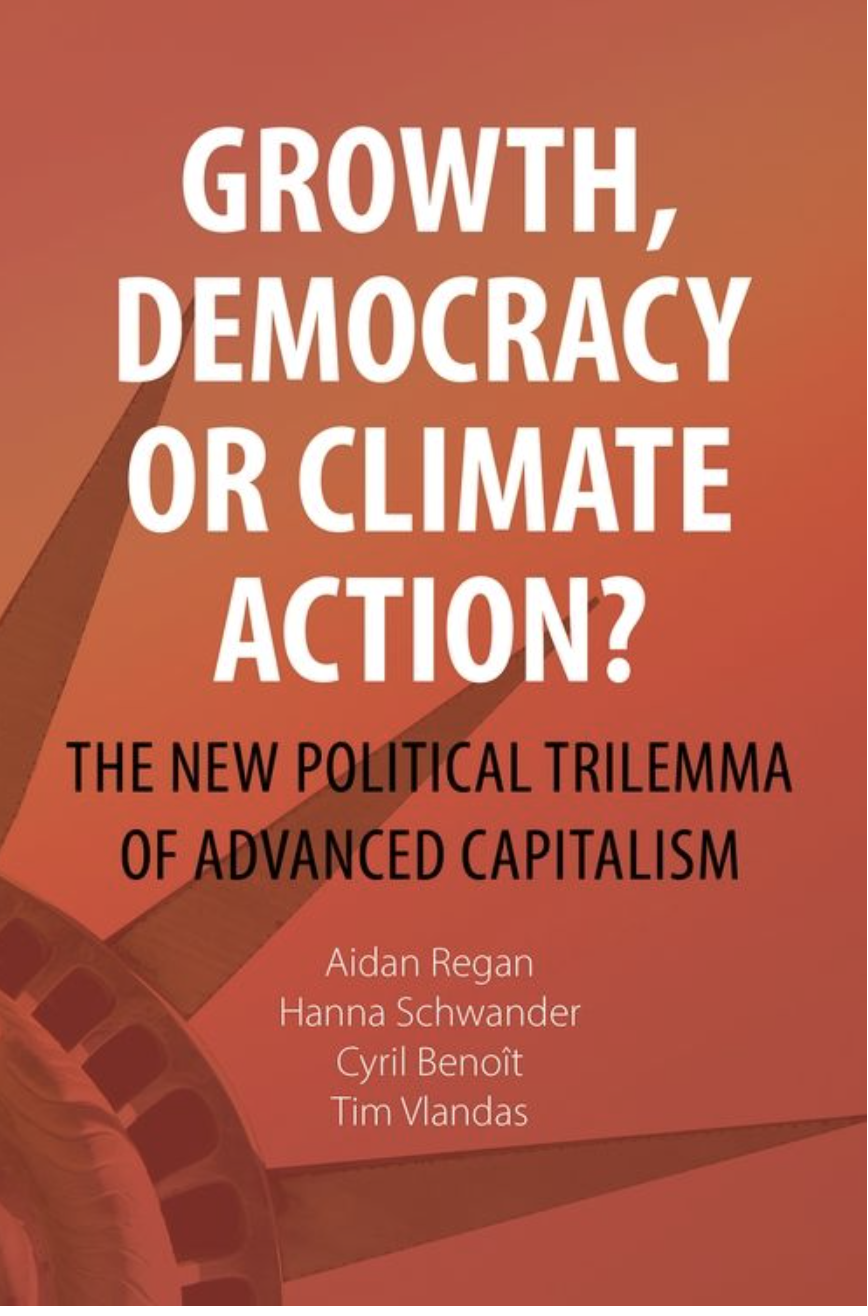
Topic: Growth, Democracy or Climate Action? The New Political Trilemma of Advanced Capitalism
Join us on Wednesday, September 16 at 10:00am EDT/4:00pm CET for a discussion of Prof. Aidan Regan’s new book, Growth, Democracy, or Climate Action: The New Political Trilemma of Advanced Capitalism (University of Edinburgh Press, 2026).
About the speaker:
Aidan Regan is a professor of political economy at the school of politics and international relations at University College Dublin (UCD). He is the principal investigator of a European Research Council (ERC) consolidator grant titled: Democracy Challenged – how corporate tax avoidance fuels the wealth inequalities that undermine democracy. The project is pursuing new foundational research on inequality and democracy.
Aidan has published ground-breaking international research on a variety of topics that include the impact of multinational corporate tax avoidance on inequality; the consequences of austerity; the diversity of modern capitalism(s) in Europe; the distribution of wealth and income in Ireland; the effect of unequal access to housing; the determinants of voting behaviour; the transformation of work and social class on social democracy; the politics of industrial relations and welfare reform; tax-avoiding wealth chains in the big tech sector; economic inequality, and the future of capitalist democracy.
About the book: https://edinburghuniversitypress.com/book-growth-democracy-or-climate-action.html
Governments face a conflicting choice between economic growth, democracy and tackling the climate crisis. They cannot achieve all three objectives simultaneously and the growing tensions between them are being played out in countries across the world. It is the new trilemma of advanced capitalist democracy.
The authors use this trilemma as a fresh analytic framework to conceptualize these trade-offs and tensions in the study of capitalist democracies. The type of democratic politics required to generate growth and prosperity within the ecological limits of the planet, they argue, has not been taken seriously in the study of comparative political economy and needs to be located at the heart of future research. Given the unprecedented scale of structural reform that governments need to implement to effectively tackle the climate crisis, the authors question whether the transition to carbon neutrality can be done within the liberal rulebook that has governed the politics of advanced capitalism for the past hundred years.
The book is co-authored with Hanna Schwander, Cyril Benoit, and Tim Vlandas.