By Niklas Romberg
A year-long fellowship program is sending Penn undergraduates into the rooms where European policy is made.
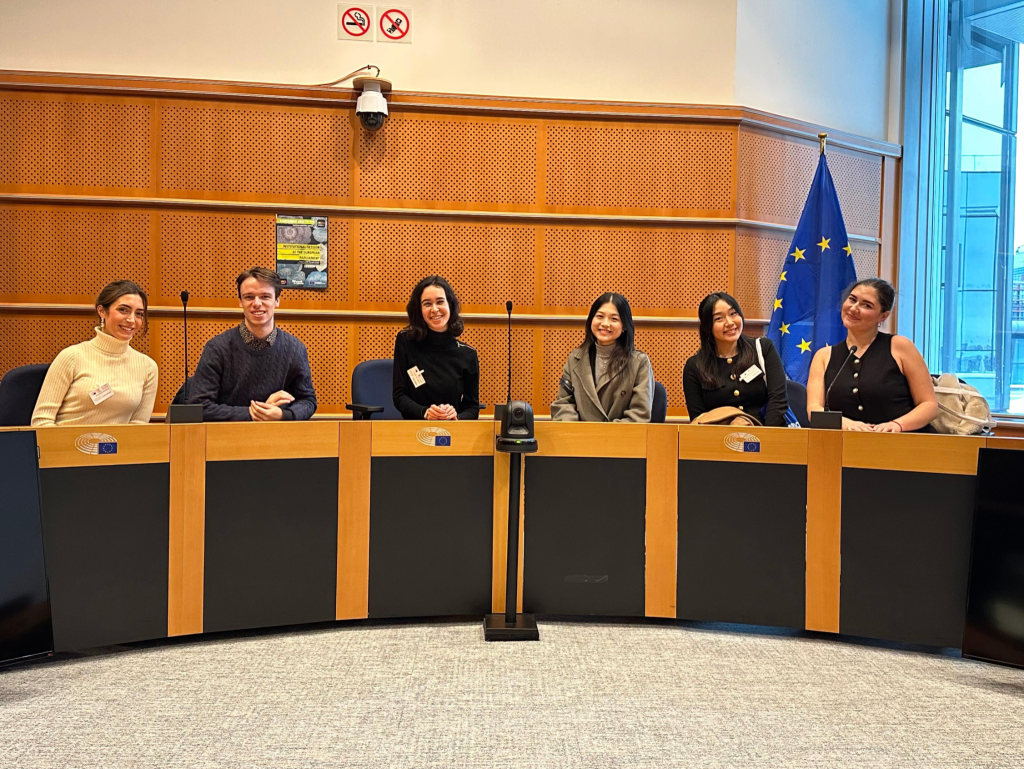
ESI participants at the European Parliament in Brussels in January 2026
There is a particular kind of education that only happens outside the classroom. The kind where you sit across from a European Commission official who treats you like a peer, or hold your own in a wood-paneled conference room in a Budapest castle, and walk away having learned something no syllabus could have taught you. For the students selected each year for the University of Pennsylvania’s European Studies Institute (ESI), that kind of education is the whole point.
Founded and directed by Professor Mitchell Orenstein, one of the leading scholars of European politics and political economy, ESI is Penn’s student-centered research institute for European studies. Each year, around seven junior students are selected to participate in a year-long program that begins in April of junior year and runs through the completion of the senior thesis the following spring. The program is ambitious by design. As one participant put it, the goal is to produce work that reads less like an undergraduate paper and more like a genuine contribution to scholarly literature.
The research
The intellectual thread running through this year’s cohort was a question that has reshaped European politics since February 2022: how has the war in Ukraine changed Europe? Each student develops their own original research question within that broader theme, with Professor Orenstein pushing them toward projects that are methodologically rigorous and genuinely new.
Thomas, a senior who participated in the 2024-25 cohort, began the program focused on Chinese infrastructure investment in Southeast Asia. Over time, his project evolved into a comparative study of how large economic powers, specifically the EU and India, respond to Chinese infrastructure in their respective neighborhoods, in Serbia and Myanmar. “The idea behind the program,” Thomas explained, “is to make a genuine contribution to the literature. You’re not just summarizing what others have written. You’re adding something new.”
Rosie, another member of the cohort, focused her research on Hungarian Prime Minister Viktor Orbán’s manipulation of the Ukrainian diaspora in Transcarpathia, a region of western Ukraine with a significant ethnic Hungarian population. Her project examined Orbán’s behavior in the context of the Ukraine war, in particular his use of the Hungarian minority in Ukraine as political cover for blocking EU military aid and freezing recovery funding. “Professor Orenstein came up with new ideas and pushed me to develop them,” Rosie said. “He doesn’t just want you to pursue something you care about. He wants you to contribute something that wasn’t there before.”
Three weeks in Europe
The centerpiece of the ESI experience is a research trip to Europe held each January. This year’s cohort traveled to London, Brussels, and Budapest, with day trips to Paris and Bruges. In past years, cohorts have visited Berlin and Warsaw.
The itinerary is nothing like a student tour. In London, participants met with academics from UCL, the LSE, and King’s College London. In Brussels, they visited the European Commission, the Council of the European Union, and the European Parliament, including a meeting with one of its Vice Presidents, as well as the Parliament’s research service. The group also visited NATO headquarters. In Budapest, they met with researchers at the Central European University’s Democracy Institute and the Danube Institute, a think tank closely aligned with Orbán’s Fidesz party.
For each meeting, students prepare questions tailored to their own research, and Professor Orenstein works to ensure that every participant gets something useful out of every stop. “The meetings are for each student,” Thomas explained. “You ask questions for your research, and then you get contacts for further research.” ESI also offers additional funding for students to return to the field independently. Thomas used this support for follow-up visits to Hungary and Serbia that he described as central to his final thesis.
His personal highlight was a meeting with the EU’s Foreign Direct Investment screening unit inside the European Commission. “I realized in that moment that I was not a professional, but I was being treated like one,” he said. “Being in those institutions, speaking with real officials who treat you as a real researcher, that was incredible.”
For Rosie, the most memorable moment came inside the Danube Institute’s headquarters, a small villa nestled on the hill below Buda Castle. “It was this wood-paneled room, snow and wind outside, packed with men, everyone very suspicious,” she recalled. “It felt like something out of a spy movie. But that’s exactly what I hoped to get out of it: being in places I never should have had access to, learning how to ask questions, learning how to be in a room with people you deeply disagree with. Doors are open that never would have been opened, had I not been in ESI.”
The bigger picture
Both students came away from the program with a stronger sense of why Europe deserves serious attention from American students. Thomas points to a basic gap in understanding. Most Americans, he argues, have little grasp of how the EU actually works, what its competencies are, how its institutions function, and how it differs from its member states. “It’s the world’s second-largest trading bloc,” he said. “It deserves more attention and more serious scholarship than it gets.”
Rosie grew up in a Russian-speaking community in Northeast Philadelphia, surrounded by immigrants from across the former Soviet Union. Her interest in Orbán’s Hungary grew out of years of listening to people who had lived through the collapse of the Soviet world. For her, European studies has never been abstract. “The EU has succeeded and failed in fascinating ways,” she said. “There are lessons in that for everyone.”
Looking ahead
Both students leave the program with more than a completed thesis. Rosie, heading to law school with a focus on international arbitration, said ESI fundamentally changed her confidence as a researcher. “Not every undergraduate at Penn writes a thesis,” she said. “Learning to manage a vast amount of information, messy interviews, contradictory sources, and turn it into something coherent, to become an expert in one specific thing: that’s a skill that translates everywhere.” Thomas pointed to something similar: being taken seriously in rooms full of experts, because you had done the work to earn it.
His advice to future applicants is simple. “Only do it if you are genuinely committed to doing a proper investigatory thesis, not just for the résumé. Prepare as much as you can before January. That trip won’t come again. Unless you do a PhD, Professor Orenstein is going to set up meetings that could be transformational for your career. Make the most of it.”
For more information about ESI and the European Studies Minor at Penn, visit web.sas.upenn.edu/european-studies.
The author would like to thank Thomas Sharrock and Rosie Berman for generously sharing their time and experiences for this piece.
Author Bio:
Niklas Romberg is a Bachelor of Arts in International Relations candidate at the University of Pennsylvania, Class of 2027.