
By Niklas Romberg
Penn’s expert on European populism has spent years alongside the movements most academics only study from a distance.
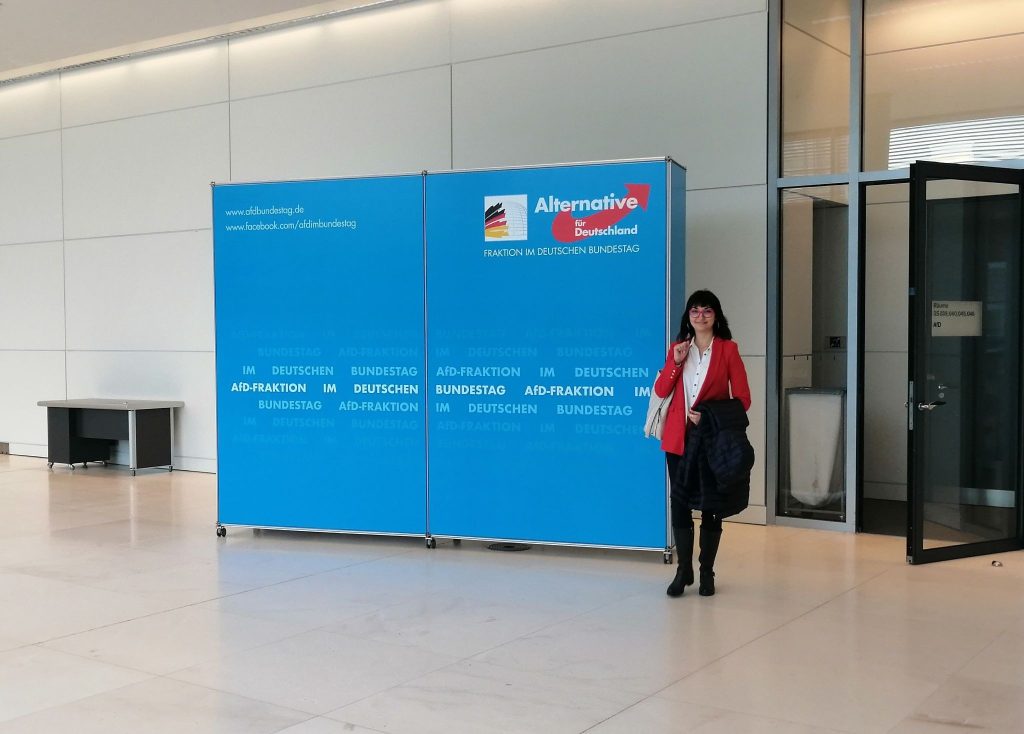
Dr. Valeriya Kamenova at the AfD parliamentary group in the German Bundestag
There are not many political scientists who have stood on a Munich street at ten o’clock at night, watching a crowd of Antifa protesters converge on a group of teenage AfD (Alternative for Germany) activists hanging campaign posters, and had to make a split-second decision about what to do next. Valeriya Kamenova has. It is that kind of fieldwork, uncomfortable, unpredictable, and impossible to replicate from a library, that has shaped her into one of the most distinctive voices in European populism research today.
Kamenova is a junior faculty member in Penn’s International Relations program, where she has taught since 2021. Originally from Bulgaria, she has lived in the United States since 2008 and brings to her research a personal familiarity with the post-communist world that informs everything she does. Her work sits at the intersection of far-right politics, European Union institutions, and foreign policy, and it has taken her into corners of European political life that most researchers never get close to.
Starting with a puzzle
Kamenova’s academic journey did not begin with the European radical right. As a graduate student, her initial obsession was with Islamic movements during the Arab Spring, particularly the Muslim Brotherhood in Egypt. She was drawn, she explains, to the fringes: the movements and worldviews that most people dismiss without trying to understand. “I have always been fascinated by the extremist and the fringe,” she said. “Religious, secular, nationalist. I want to understand why people see the world the way they do, what threats they perceive, what their life story is.”
The pivot to the German radical right came partly out of circumstance and partly out of opportunity. She spoke German, having studied it since high school and completed a master’s degree in Bremen, Germany. When the AfD began its political rise, it presented a puzzle she could not resist. Germany has some of the strongest social and legal constraints in the world against far-right politics, a product of its history and its postwar constitutional architecture. How, then, was a party like the AfD not just surviving but growing? That question became the engine of her PhD and remains at the center of her work today.
The answer she found was not what she expected. The AfD, she argues, is remarkably good at presenting itself as internally democratic. Rather than operating as a top-down authoritarian movement, it has built its base by absorbing and mobilizing a diverse range of social movements, from evangelical Christian networks to Islamophobic groups to the international identitarian movement. It has cultivated connections with like-minded parties in Austria, France, and beyond, and it has learned to legitimize those connections in ways that resonate with its supporters. “They are not just old racists,” she said. “Many of them are highly educated. Each of these people has a story. I spent time with people whose opinions I deeply disagree with, and I think that is exactly what we need more of. We lack dialogue. I want to be a bridge.”
A year and a half with the AfD
The fieldwork phase of her research took Kamenova to Germany for a year and a half, during which she embedded herself with AfD activists and observed the party from the inside. It is the kind of research that demands a particular combination of intellectual discipline and personal resilience. As a woman, as a foreigner, and as someone whose politics are entirely at odds with the movement she was studying, she navigated those spaces carefully and not always comfortably.
The night in Munich stays with her. It was election season, and AfD activists, mostly young men in their late teens, were hanging campaign posters after dark, since the stigma of being publicly identified as AfD supporters meant they preferred to work under the cover of night. A crowd of Antifa protesters spotted them and began to gather. Kamenova found herself in an impossible position. As a researcher, she is obligated to report a crime if she witnesses one, but equally obligated to protect the identity of her informants, and doing both at once is not always possible. She also had her own safety to think about: standing among AfD activists, she had no way of knowing whether the approaching crowd would see her as any different. She left before things escalated, and heard later that there had been physical confrontations. “Actual violence is not fine,” she said. “Elections and dialogue are how you fight these things, not by fighting each other on the street.”
That experience crystallized something for her about the nature of political polarization in contemporary Europe. The radical right does not exist in a vacuum. It is shaped by the reactions it provokes, and those reactions in turn shape it further. Understanding that dynamic requires being present in a way that no amount of survey data or parliamentary record analysis can replicate.
From Germany to Penn, and beyond
Since arriving at Penn, Kamenova has expanded her research focus to include the foreign policy dimensions of far-right movements. She is currently examining how parties like the AfD leverage their international networks and how they justify collaboration with movements in other countries, including ties to parties sympathetic to Russia and connections to MAGA-aligned networks in the United States. The question of how the radical right legitimizes its foreign entanglements in front of its own supporters is, she argues, one of the least understood aspects of contemporary right-wing politics.
Kamenova is an affiliated faculty member of the ESI and sits on its advisory council, working closely with Professor Orenstein to advise students on senior theses related to European Union politics and participating in faculty workshops on EU issues. Teaching, she says, is one of the most rewarding parts of her work. “IR students work in a very intimate way with me for a year and a half on their thesis,” she said. “When they come back and tell me how much that work contributed to their career, that is one of the most amazing things to hear.”
What the radical right reveals about the EU
Spending years studying the EU through the lens of its most vocal critics has given Kamenova an unusual perspective on the institution. She is candid about what the radical right gets right. The EU is slow. Its bureaucratic machinery is often ill-suited to the pace of contemporary threats, whether in security, technology, or trade. “The Commission is too slow, and there is too much politicization,” she said. But she is equally candid about what the radical right gets wrong. “When you step back, you see that many of the EU’s regulations, even the slow ones, end up having a genuinely positive impact on people’s lives. Food safety standards, data privacy: these things matter.”
Her broader assessment of the EU is that it is a powerful actor when it finds the will to unite, but that it is too often paralyzed by the fear of stepping on the toes of national governments. That tension, between the ambitions of the European project and the political realities of its member states, is precisely what the radical right has learned to exploit.
For American students, she argues that understanding the EU is not optional. It is the world’s largest trading bloc, a critical security partner for the United States, and the most advanced experiment in democratic governance among multiple sovereign states that the world has ever seen. “If you want to work in business, in security, in anything that touches the international sphere,” she said, “you need to understand how the EU functions. Not as a vague backdrop, but as an institution with its own logic, its own constraints, and its own possibilities.”
The author would like to thank Dr. Valeriya Kamenova for generously taking the time to sit down for this interview.
Author Bio:
Niklas Romberg is a Bachelor of Arts in International Relations candidate at the University of Pennsylvania, Class of 2027.